
The Archaeology Group’s November lecture was given by Abigail Parkes, who is researching for her Ph.D. at Southampton University. Using a combination of experimental archaeology and engineering techniques, Abigail’s research aims to increase our understanding of the weapon and how it was used in maritime conflicts.
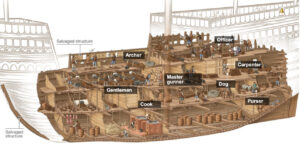
Well-known for leading England to victories over their enemies during the Medieval period, the longbow has gained a reputation as a formidable and unbeatable weapon, with its importance remaining evident in today’s popular culture. Yet, what we know about the reality of the weapon is hardly anything at all. Prior to the excavations of Mary Rose, there were no surviving examples from the period of the weapon’s greatest usage. The collection of 172 longbows recovered from Mary Rose therefore offers a unique opportunity to learn about the weapon in general, as well as its use at sea.
Abigail began by correcting the misconception that the Longbow is named for its size; in fact, the name refers to the vertical (longwise) orientation in which the bow is used, in contrast to its horizontal (crosswise) cousin, the Crossbow.
After describing the main features and characteristics of the longbow, Abigail talked about the ranges of size and shape that have been found amongst the bows recovered from the Mary Rose. These variations raise the question at the centre her research: were they merely compensating for differences in the material properties of the bows so that they would perform consistently, or do they reflect different ways in which the weapons were used? Clearly it is not possible to mechanically test the actual longbows from the Mary Rose, so Abigail is using replica bows to investigate how their draw strength, range and accuracy are related to their dimensions and the microscopic properties of the wood from which they are made. This will allow her to build up a database which she can use to deduce the range of performance and probable applications of the actual Mary Rose longbows.
Abigail explained that her research had been interrupted by the Covid-19 pandemic, so not all the tests had been completed, but she presented some of her initial results. She also highlighted a recent book in which she had co-authored a chapter (Facing the Sea: Essays in Swedish Maritime Studies, eds. S Ekström and L Müller, Nordic Academic Press, 2021) and a two-day course that will take place in 2022*.
The evening ended with a lively discussion, reflecting the audience’s interest in Abigail’s very engaging presentation. One of our members was even able to point Abigail towards a possible supplier of nettle fibre, which could help in her research into the performance of different bowstring materials*.
*Author’s note: I’m afraid I don’t remember the details here, if you have more information or a better memory please send us an email!